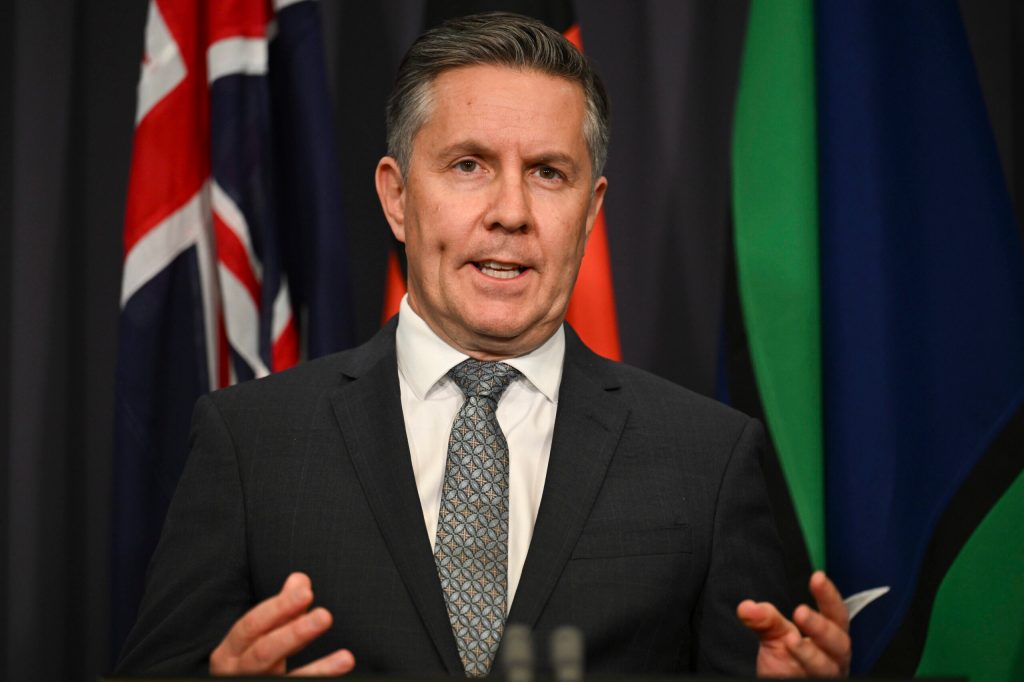
Health Minister Mark Butler says states will not be forced to grant children with gender dysphoria access to puberty blockers, despite advice of the country’s top health research body recommending access if children, their legal guardians and clinicians agree it is the best course of action.
The National Health and Medical Research Council (NHRMC) on Monday released its advice on the medications, which stop the body producing oestrogen and testosterone, halting unwanted physical changes in pubescent children.
Queensland and the Northern Territory imposed bans on puberty blockers in public hospitals, prompting the NHMRC to review the guidelines, but both governments said the bans would continue in the wake of the updated advice.
Mr Butler said despite the advice he would not stand in the way of such decisions.
“That’s entirely their right, they are elected governments. They’re accountable to the people of Queensland and the Northern Territory,” he told Nine’s Today.
“I just took the view that with this very heightened public debate about a very, relatively small group of very vulnerable young people who are vastly over represented in our mental health and suicide statistics … we should refer it to the pre-eminent health and medical research body of Australia, which for 90 years has been developing the guidelines to guide clinical practice right across the health care system.
“I’m sure that governments will look at these guidelines very closely, but at the end of the day, every state government who deliver these services in their pediatric gender clinics will make their own decision about this.”
Mr Butler said his priority was making sure patients receive the “best possible clinical care”.
“At the end of the day, I think what families and the broader community want is to know that their doctors, where they’re taking their children, who are in a highly distressed state, very vulnerable to mental health and even suicidal ideation, are getting the best possible care and support that is available,” he said.
The use of puberty blockers may help to affirm gender identity and even avoid surgery later in life, but there are potential side effects including reduced bone density and fertility, and some long-term effects are still being investigated.
NHRMC acting chief executive Prue Torrance said the decision on accessing puberty blockers needed to be holistic.
“Young people and their families should be able to have informed discussions with their healthcare professionals, supported by the best available evidence and clear, trustworthy clinical guidance,” she said.
“Puberty suppressants are one possible part of care, and decisions about their use need to be made through shared decision making that involves the individual young person, their parents or carers and clinicians.”

The NHMRC advice recommended puberty blockers can be considered for a child seeking the medications when they have started puberty, have mismatched gender identity and found suitable for treatment by doctors.
The council noted that “treatment may be appropriate for some individuals but is not a one-size-fits-all decision”.
“Shared decision-making involves young people, their parents or carers and clinicians discussing the available evidence, potential benefits and harms, and the young person’s individual circumstances and preferences before deciding together whether treatment is appropriate,” it said.
The NHMRC will leave its advice open for public comment until January 18, with the feedback to be used to inform the final guidelines due in 2028.
Fronting media in Canberra on Monday, Mr Butler urged people to be mindful with how they engage, warning that young trans Australians are “vastly over represented in mental health and suicide prevention statistics, reflecting still very high levels of stigma and discrimination generally around these issues”.
“This is … an area of clinical practice that attracts a lot of public commentary and public debate,” he said.
“And that is understandable, given we’re talking about children and adolescents, particularly children and adolescents who are often quite vulnerable.
“Not all of that public commentary and debate is always constructive, and frankly sometimes it runs the risk of being quite damaging, particularly damaging to the mental health of those young Australians and their families.”