
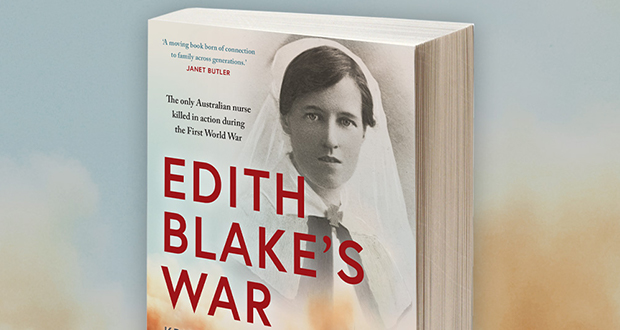
From a bundle of old letters and a diary from 1914, Krista Vane-Tempest unearthed the story of the only Australian nurse to die in action during the First World War.
As a child, Krista knew she had a great aunt who had served and died on a sinking British hospital ship. But her family, namely her grandmother, had rarely mentioned her big sister Edith.
It wasn’t until Krista inherited Edie’s diary at 19, did she realise the harrowing journey that her lost relative had embarked on.
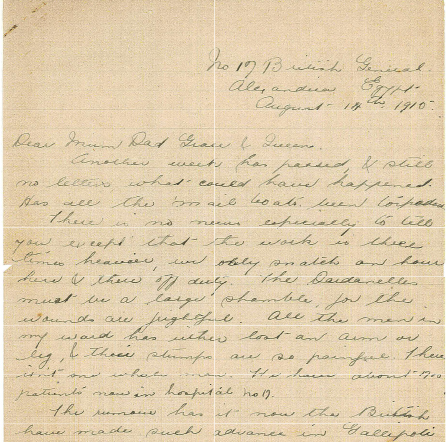
Years later her father found a bundle of tied up letters stuffed in the bottom of a wardrobe. They had been written by her great-aunt during her nearly four years of war service.
“I was shocked,” Krista told Nursing Review.
"So it wasn't until that, I or Dad, in fact, became aware that all of this treasure trove of letters and photos and things existed.”
In around 100,000 words, Edie had penned her days as a trainee nurse in south-east Sydney, her voyage over to Egypt with the British army, and her mixed relationship with German prisoners of war in England.
In 2014, Krista began typing up each of the 135 handwritten letters, and slowly brought Edie’s story to life.
Her book, Edith Blake’s War, was published earlier this month.
“The first point to make is I'm not a nurse,” said Krista, who studied English, law and history before becoming a lawyer.
“My only experience with nurses is when I've been to the doctor or had my kids in the hospital.
“Writing this book really showed me how tough and practical they had to be or became in doing that role, and it was really clear that nurses do tend to be pretty no-nonsense about stuff.”
Edie Blake grew up in Darlington and came to train at the Coast Hospital, now known as Prince Henry Hospital, when she was 23 years old.
Choices for women were limited back then, but nursing was an acceptable option for young, middle-class girls, or as Krista puts it, “the eldest, unmarried daughter”.
It was almost 30 years after the smallpox pandemic had hit Sydney and the conditions at the infectious diseases hospital were horrific.
Nurses found themselves sponging grimy skin, shaving lice-infected heads, directing blowlamps on the bunks to kill bed bugs, and washing dirty garments.
When the great war broke out, more than 2,000 civilian Australian nurses would enlist for service, including Edie.
In 1915, she was allocated to the British Queen Alexandra’s Imperial Nursing Service.
She boarded a ship headed for Cairo and would spend 18 months tending to the shrapnel, bayonet and shell wounds carried by soldiers fighting in the trenches of Gallipoli.
“In those days, you hoped that you were born with a pretty resilient constitution, I think, because you'd be exposed to all sorts of things,” said Krista.
“They're really expending a lot of physical and emotional energy, doing all of those tasks that needed to be done and having relationships with the patients, much more so than the doctors.”
After the Western allies attempted to seize control of the Gallipoli peninsula, over 10,000 wounded men would be transported to Edie's hospital at Alexandria.
As the casualties flooded in, the nurses treated the sick and dehydrated soldiers, many of whom had facial deformities, blown off body parts, and open trench wounds.
The nurses worked until exhaustion and often fell sick from bugs caught off their patients.
In the present world of COVID-19, where health workers face a new form of widespread sickness and devastation, Edie’s experiences draw a noticeable parallel.
“I feel like in a way we've got a little bit of an understanding of what it must have been like to be in a world at war,” said Krista.
“A lot of people have probably had a similar experience of not being at war as such, but where the world has just been flipped on its head and you just have to cope with it.”
Krista details how the staff nurses, who were often several years older than the boys, would offer empathy and emotional support.
“Surrounded by human wreckage, the nurses knew that although their immediate duty was to minister to their patients’ physical wounds, it was vital to keep up their spirits,” Krista writes in the book.
“To be washed clean, to have a sweet cup of tea – indeed, to be in a place where women existed marked a return to civilisation after the privations of the trenches and the shock of fighting.”
After 18 months in Egypt, Edie would transfer to Surrey, England, where she would care for wounded German prisoners of war.
Britain was under fire from weekly German aerial bombing raids.
Witnessing the bombers from her bedroom window every night, Edie would enter the ward the next morning and chat with her foreign patients and learnt a word or two in German. This struck Krista.
“It's interesting because it brings out the idea of who is your enemy? Because when she's dealing with them one to one, they're just her patients in a bed,” she said.
“Edie loved nursing Australians, but she cared for all of her patients as human beings, regardless of where they came from.”
In November 1917, Edie boarded the HMS Glenart Castle, a hospital ship bound for the Mediterranean.
Four months later, the ship was struck by a torpedo launched from a German Submarine in the early hours of the morning.
Most of the crew members and medical personnel, including 32-year-old Edie, drowned with the vessel. According to Krista, she was the only Australian war nurse to have died in action during the First World War.
While finishing the book, Krista travelled to England to attend a ceremony for the sinking of the ship.
She met the distant families of Edie's past colleagues and a host of extended Blake relatives.
“Unfortunately the experience for those families is pretty much the same as for ours, in that nobody really spoke about it," she said.
"You know that they did that service, but no one's alive that I know of, that actually had any kind of in-depth conversation with these people about those experiences, it was just something that happened to them in the past.”
Years before finding the letters, Krista, a volunteer at the Australian War Memorial in Canberra, searched for her great aunt on the roll of honour.
As Edie was allocated to the British Army, she was not recognised on the list of men and women who died serving Australia.
"World War One is a great watershed. It's a great social watershed as well because women did step up and serve their country," said Krista.
“I would like people to see that the book not only tells a story of Edie, but of nurses, and of being a woman and an Australian at that time in history.”
Edith Blake’s War is now available online for purchase.



1 Comment
ectaylor@bigpond.net.au
What an amazing find. Thank you from a nurse who loves blending old and new, and the facts about our great beginnings.