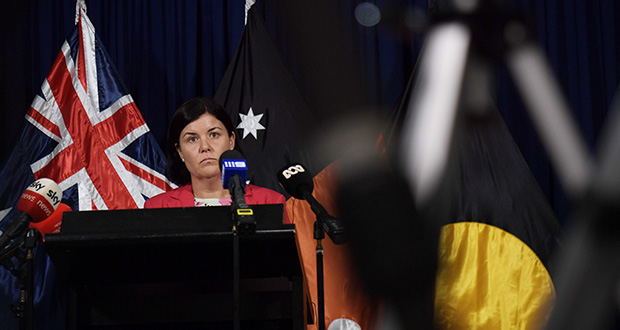
The Northern Territory government will strengthen alcohol restrictions in Alice Springs following a rise in alcohol-fuelled crime.
Frontline workers, including a nurse, have opened up to the media about their experiences during shifts, which included cases of child abuse and domestic assault.
Data from the NT police revealed that alcohol-related assaults rose by 55 per cent in 2022, and domestic assault increased by nearly half.
"We've heard loudly and clearly that the matter and decision of alcohol on community need to be made by the entire community," NT Chief Minister Natasha Fyles announced Monday.
"That is why we're creating a circuit breaker and implementing temporary dry zones until communities can develop and vote on the alcohol management plans, the community alcohol plans they want to see.
"It is important for all of us as Territorians to tackle this issue once and for all."
Healthcare workers are four times more likely to be seriously injured by violence than other professions in Australia.
Additionally, over 95 per cent of nurses said to have experienced verbal or physical assault at least once while on the job.
"We must take a zero tolerance to violence to ensure we will not have to wait until after a woman has been harmed to act," ACN chief adjunct professor Kylie Ward said.
"It is unacceptable that despite shifting societal attitudes, nurses are placed in danger."
Prime Minister Anthony Albanese flew to Alice Springs earlier this year to respond to the crime crisis in Alice Springs.
On Monday, he announced a new $250m package to support youth engagement and diversion programs, job creation and improving health services.
"The truth is that all governments could have done better. All governments – Labor, Liberal, Northern Territory, here in Canberra, could have done better," he told parliament.
"This is about intergenerational disadvantage. It is about a lack of employment services, a lack of community services, a lack of educational opportunity."
The announcements came after Central Australian Regional Controller Dorrelle Anderson's report was released publicly, calling for immediate restrictions for takeaway alcohol and extra federal funding.
Anderson was appointed after Albanese and Fyles had crisis talks in Alice Springs last month.
"Although the NT has some of the most rigorous and world-leading supply measures in place, it is clear that additional work is required to act as a circuit breaker in Central Australia," Anderson wrote.
"We need to allow service agencies, including Police, child protection and health providers, the necessary time to engage with those affected and support them.
"A failure to seriously address the underlying drivers of alcohol misuse and youth crime will mean these harms will continue to return year after year."
Fyles said temporary alcohol restrictions imposed on January 24 had already provided "respite" to communities.
She pledged bans would be reinstated in Central Australia to prevent the sale of alcohol to people in town camps and remote communities.
Under legislation expected to be introduced next week, alcohol management plans will be able to be modified if 60 per cent or more of the community supports the changes.
The intervention introduced in late January came after political pressure from opposition leader Peter Dutton, who urged the prime minister to address an escalating 'tragedy.'
Many indigenous communities will be unaffected because they already have alcohol bans in place.
Fyles said she knew some people would be disappointed the NT government would not introduce blanket alcohol bans, defending her proposal as allowing local communities to address the issue with a 'clearly defined process.'
She said the legislation would not be a return to the stronger futures policy, which expired in July 2022.
The 'big message' the rest of Australia needs to hear is that 'this is not just about alcohol', radio broadcaster Katie Woolf told Sky News host Erin Molan.
"We've got a serious issue across the NT with youth crime."
"If you ask places like Mount Isa, places like Townsville, it is taking place right across Northern Australia."