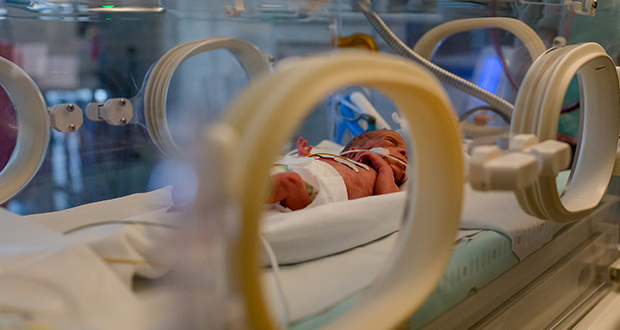
Aiming to wait at least 60 seconds before clamping the umbilical cord in premature babies can significantly reduce their risk of death and disability, new research has found.
Researchers from the University of Sydney analysed the outcomes of 1500 pre-term babies two years after they had been born 10 or more weeks early.
For the babies who didn’t require urgent resuscitation, delayed clamping allowed more time for them to start breathing unaided and for critical blood cells to flow into their bodies, reducing their chances of death or disability by 17 per cent.
According to experts, changing official guidelines to include delayed clamping for very premature infants could help to save thousands of lives worldwide.
“If all preterm babies were to have this policy over the next decade, then compared with the first 10 years of this decade, there'll be 50,000 extra babies surviving without major disability around the world,” said the study’s co-lead Professor William Tarnow-Mordi.
“We now know that if you do wait for 60 seconds, most babies will start to breathe within that minute.
“As a quarter of babies in the delayed clamping group did not get the full 60 seconds delay, I think that the results that we've got are probably an underestimate of the benefits of delayed cord clamping.”
Globally, around one million babies are born before 30 weeks’ gestation every year.
In high-income countries, roughly 25 per cent of premature infants born before 30 weeks will die or develop a major disability, such as the onset of cerebral palsy or cognitive difficulties, before the age of two.
Dr Kristy Robledo, who led the study’s two-year follow up, said the findings come as a reassurance for parents who may experience preterm birth.
“It’s so simple and universally affordable, and it does not require any expensive equipment or training in order to do, you just need to start a stopwatch and wait for 60 seconds,” she said.
While delayed cord clamping is standard practice for full-term babies in almost every maternity unit across Australia, before this research babies born very prematurely often had their cords clamped quickly in case they need resuscitation.
President of the Perinatal Society of Australia and New Zealand and former president of the Australian College of Midwives, Professor Caroline Homer, said training will be vital to spread the word to healthcare staff.
“Changing practice is really hard, everyone likes to do what they’ve always done,” Homer told Nursing Review.
“I think we need really good dissemination of this information to midwives and obstetricians, but also to the neonatal staff.
“I think it’s also about informing parents and the people who are going to be in the birth room at the time and being really clear that this is a good thing.”
Asking practitioners to do things differently may be difficult, said Homer, therefore guidance will be essential to implement any new guidelines.
“We need role models to be brave enough to start doing this routinely everywhere," she said.
“We also need good communication because it’s a real challenge if one clinician jumps in and wants to cut the cord, and another wants to wait, you don’t want that kind of tension when a baby has just been born.”
Researchers from the University of Sydney will now work with organisations, parents, policymakers and individuals in a global collaboration that aims to build even larger randomised mega-studies of other simple, low-cost interventions.