A first-of-its-kind spray coating has been developed that can help prevent future Covid and bacteria-related deaths by reducing the spread of pathogens on surfaces.
The coating fends off infections by resisting the uptake of bacteria and viruses that accumulate on surfaces through touch and droplets.
The study from the University of Melbourne, published in the journal Advanced Science, could be a welcome development for hospitals and medical centres that have already faced three Covid waves this year.
Today, just under 2,000 Australians are in hospital, and 55 people are in ICU due to Covid, with NSW taking the lead with 1,176 hospitalised cases.
Professor David Nisbet, director of the University of Melbourne's Graeme Clark Institute, says viruses such as Covid can remain infectious on surfaces for up to a week.
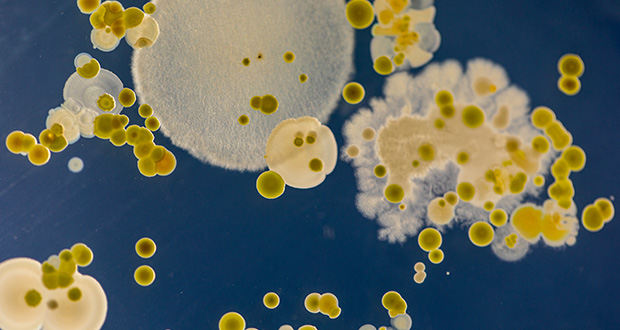
"Our coating successfully prevented up to 99.85 per cent and 99.94 per cent of the bacteria strain growth. We also saw an 11-fold reduction in virus contamination," he says.
Although the spray coating has advantages in preventing Covid, Nisbet says it's most valuable in fighting the global war against antimicrobial resistant (AMR) pathogens.
When a microbe becomes AMR, it evolves specific mechanisms so it no longer responds to medicines, hindering the treatment of infections and diseases.
"Antibody-resistant bacteria are a hidden pandemic at the moment," Nisbet says.
"We're finding more and more bacteria resistant to antibiotics on a daily basis."
A global survey recently revealed the staggering death toll of these 'superbugs' – it estimated that in 2019, 4.95 million people died from illnesses where AMR bacteria played a key role.
AMR infections killed more people than HIV/AIDS or malaria that year, as 1.27 million deaths directly resulted from drug-resistant infections.
"This is where the spray coating is a knockout performer because bacteria are all surface-based transmissions."
The coating can be applied to surfaces such as lift buttons, stair rails, surfaces in hospitals and nursing homes, and even sticks to blotting paper and bricks.
That's because the spray coating is made with a combination of plastics strong enough to be considered an alternative to bullet-proof glass.
"People have done other things, particularly with making nanostructures out of silica, which is pure sand," Nisbet says.
"But the problem is they're not stable. You wipe your finger across and the coating is gone, which is not practical if you think about hospitals, food preparation areas, etc.
"We've managed to make those durable, so we've stabilised that structure where it can remain in service for up to 18 months to two years."
The team has set up a start-up company to advance the spray coating's technology and make the spray available commercially within three years.
"There's a whole bunch of different variants that we have: we can make the coating transparent or a little bit hazy," Nisbet says.
"The science is done, so we're ready to sell.
"But we need to go through approval first for objects that come in direct contact with people."