Using federal funding to come up with a better pay offer for NSW nurses has been ruled out, just one day after union members gathered to demand increased pay in line with other states.
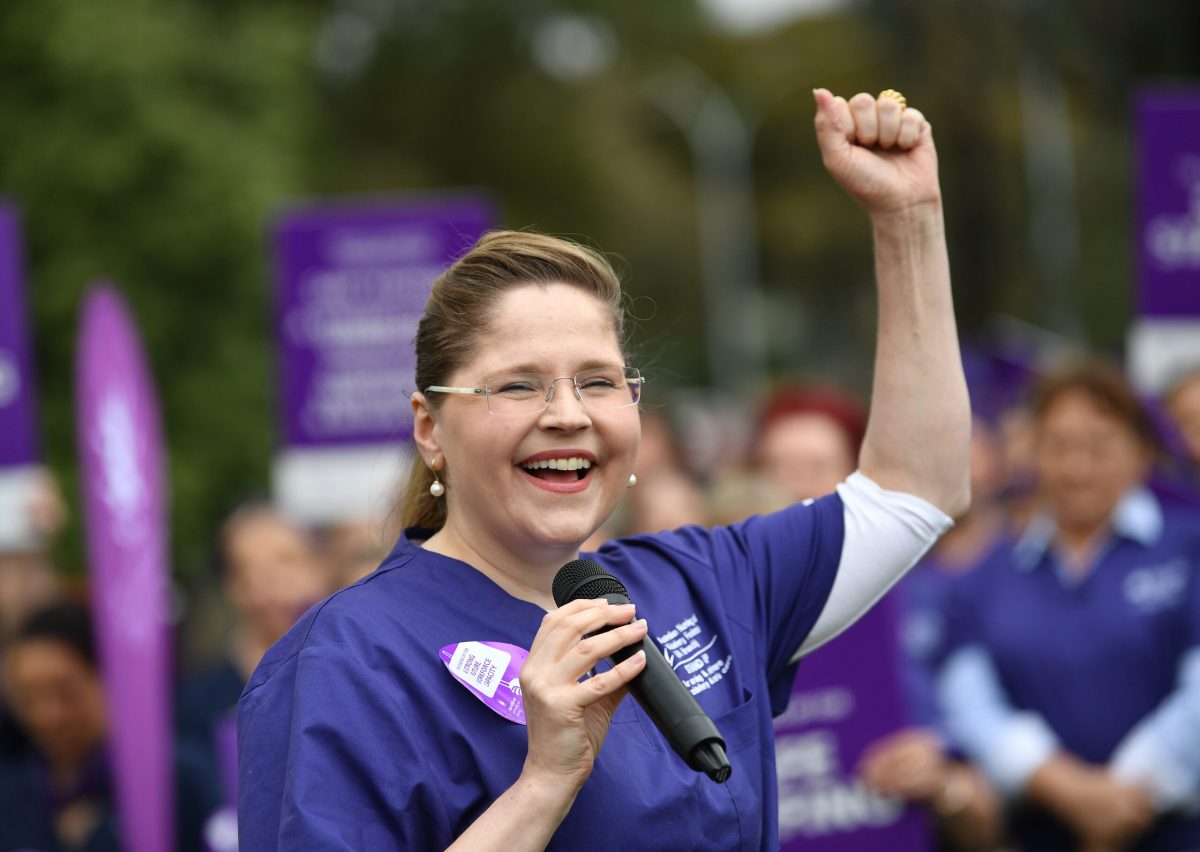
Members of the NSW Nurses and Midwives Association (NSWNMA) gathered to demand the government direct new money to ensure nurses and midwives get fair and equal pay in line with other states, claiming the workforce was leaving for better paid jobs in the private sector and interstate.
Addressing budget estimates, NSW Health Minister Ryan Park said he hadn’t improved the wage offer of 10.5 per cent over three years following the federal government’s recent announcement of $1.7bn to fund public hospitals.
He said it was “one-off” money, which means it can't be used for remuneration increases, explaining that if he were to use it for that purpose it would only be short-term fix as it wasn't ongoing funding.
“So what I would be doing is essentially saying... you could have this amount for essentially one year while your wages are adjusted, and then it has to go back, because there’s not a flow on. We did not secure a five-year deal,” Mr Park said.
Mr Park said a better GST deal from the Commonwealth could help with wage increases, as well as a five-year national health reform agreement rather than the one year offered.
Nurses' wage cap set out ‘big gaps’: Park
Mr Park was asked about whether the fact that NSW nurses are the second lowest paid in the country is contributing to the challenge of filling vacant positions.
When asked whether he was happy with the progress of the safe staffing levels initiative, which aims to bring in more nurses at hospitals under minimum staffing levels, Mr Park said he wanted it to be rolled out “faster”.
“Well, probably those who know me know that patience is not one of my strengths, so I always want it to go faster,” Mr Park said.
He said recruitment of healthcare workers was a challenge at a state, national and global level.
“We are moving at a fairly rapid rate, and I will continue to personally drive it as hard as I possibly can.”
“I’ve been clear, I think having a wage cap in place [in NSW] for 12 years has seen big gaps set out,” Mr Park said.
“One of the reasons we moved very quickly last year to remove the wages cap was to try and start the process of rebuilding.”
“We haven’t got that issue resolved yet. We remain in discussions with the Nurses and Midwives Association, I met with them a few days ago.
“We’ll continue to have those discussions, it’s in the Industrial Relations Commission. We’re not resolved yet, but we remain at the table.”
Opposition criticism
Mr Park was earlier accused of “cherry picking” after releasing health data on the busiest hospitals in the state ahead of estimates proceedings.
The data highlighted improvements to treatment times across the busiest emergency departments in the state, including Liverpool ED, where the average treatment time for triage 2 emergency patients halved from 18 minutes to nine minutes over the last year.
However, the data’s release just hours before estimates kicked off was slammed by Liberal MP Natalie Ward, who accused Mr Park of “cherry picking” data.
She pointed out the statistics shared were positive and claimed the Bureau of Health Information data was not released in full to the public.
“I don’t know if it’s cherry picking, it’s NSW Health data,” Mr Park said.
“This is data that’s NSW Health data that’s released every three months.
”It’s understood the data was a snapshot from December last year, but the BHI will release the data in full. He said the BHI released data every three months.
“What I’ve chosen to do, because I want to dive into the data and where some of our busiest hospitals in the state are performing,” Mr Park said, adding that he wasn’t suggesting there wasn’t room for improvement.
“I’ll continue to release data, there are plenty of days in this portfolio where things don’t go as you like, that’s also an area where I front up,” he said.
“I also need to acknowledge the work of health staff in these really busy hospitals who are making a pretty massive difference in terms of their efforts.
“When I have data … I don’t think it hurts to give that staff a pat on the back.
”He said the availability of primary care was not as robust as it may have been when his generation was younger.
“There was an assumption people could access GPs, and bulk-billing GPs locally, close to home … that’s not the case,” he said.
He said people were presenting to ED’s “sicker”.
“I’ve got to get onto that big time,” he said.
Mr Park said more people needed to be seen outside of hospitals, hence why the government had invested into ED relief via alternative pathways.