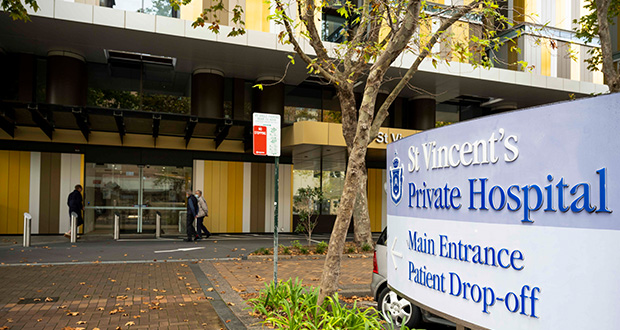
One of the country’s largest healthcare providers has brought together clinical leaders from across its hospitals and aged care services to help guide the safe, ethical and effective use of AI in healthcare.
St Vincent’s has established a national Artificial Intelligence Clinical Council that it says will play a key role in identifying, evaluating and scaling technologies that improve patient care and clinician wellbeing, while ensuring AI adoption remains grounded in clinical expertise and compassionate care.
The council includes representatives from across St Vincent’s public and private hospitals, aged care services, research programs, home care, and virtual care operations. It has been established as the organisation pushes for health and aged care to be recognised as priority sectors in Australia’s emerging AI standards and infrastructure framework.
St Vincent’s chief medical officer Dr Chris Robinson said the council reflected the organisation’s commitment to ensuring clinicians help shape the future of healthcare technology.
“Artificial intelligence has the potential to transform healthcare, but only if it is implemented in ways that strengthen, rather than diminish, the human relationships at the heart of care,” he said.
“The purpose of the St Vincent’s AI Clinical Council is to bring together clinical expertise, operational experience and community perspectives to help identify where AI can make the greatest difference for patients, residents and staff.”
The Council will provide clinical oversight and advice as healthcare providers increasingly explore how AI can support patient care, workflow efficiency, and service delivery.
Dr Robinson said St Vincent’s national footprint positioned it well to assess both the opportunities and risks associated with emerging technologies.
“Because we operate across hospitals, aged care, research, and care in the home, we are exposed to a wide range of patient needs, clinical environments, and levels of digital maturity,” he said.
“That gives us a unique perspective on how AI can be used safely, responsibly and equitably across the health system for the benefit of people – both who are cared for by the system and who work in the system.”
The launch coincides with a broader push by St Vincent’s for Australia to develop sovereign healthcare AI capabilities.
In its submission to the federal government’s consultation on AI standards and frontier AI infrastructure, the organisation warned Australia risked becoming reliant on overseas technology providers despite possessing world-class clinical expertise and valuable health data assets.
Dr Robinson argued the country faced a crucial choice between developing local capability and importing overseas AI models.
“How we approach our decision-making around these opportunities matters. The real choice Australian governments, agencies, and businesses have is to ‘build or buy’,” he said.
“The ‘build’ path enables the development of local capability and superior performance utilising Australia’s own population health data.
“The ‘buy’ path – buying into overseas AI health models – risks hollowing out local capability and creating dependency on foreign companies.”
Despite AI’s potential, Dr Robinson said technology must remain secondary to person-centred care.
“Healthcare is fundamentally a human relationship. No technology can hold a frightened patient's hand, comfort a family in distress, or sit beside someone approaching the end of their life,” he said.
“Technology must always remain in service of the clinician-patient and carer-resident relationship.”