A university in the Northern Territory is refurbishing their clinical simulation suites to better prepare their nursing workforce for the state's healthcare challenges.
Dean of CDU's College of Nursing and Midwifery professor Karen Francis says NT's health system is in dire need for nurses with a specific skill set.
"We've got problems with renal disease and undiagnosed mental health in our indigenous population up here and everything that goes with disadvantaged people," Francis says.
"So, we need to prepare our nurse students for the difficulties they might face working in the NT."
Nursing Review spoke with Francis about recruiting young nurses into the rural workforce and how technology has been used to help them prepare.
NR: So what does the new building look like, and why did it need to be built?
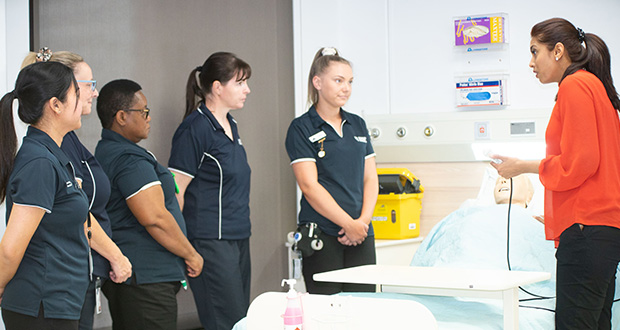
We had at our site here in Casuarina in the Northern Territory, which has a fairly old building with a couple of well-established simulation rooms, and traditional-looking simulation rooms. They look like the Nightingale ward with its 20 beds, roughly ten students per suite, and we've got three suites. So, now they're being upgraded with new technology. But they don't look like a healthcare environment; they look like a simulation lab of yesteryear.
So we have taken some office spaces used in the same area as the simulation labs and turned those into other health environments where midwives operate. For instance, we now have a procedure room day with reclining chairs. It's not currently being used but will be used to simulate when students have to do renal dialysis, chemotherapy, and short-stay lab work after the operation theatre.
When you walk into it, it's all pressure-painted; vinyl is put right through the floors. So it looks like a hospital or a health care service. We also have small procedure rooms and consulting suites, all the things you would find in modern-day health services.
How would this help prepare the future generation of nurses?
We argue that what we've traditionally done, like most universities, is provide a suite in which students practise skills. But the suite needs to reflect the diversity of places in which nurses truly work. That's what we're trying to create while setting up an environment where students track other disciplinary paramedicines, medicine, social work, pharmacy, and psychology.
They may or may not be doing the same-based scenario learning, but the fact that they're in the same space and have to work out how to interact in that space as they would if they were working in any suite is beneficial to their learning process. We're trying to increase the reality and, at the same time, without definitively having an interprofessional curriculum yet, provide the opportunity for shared learning so that they start to understand the roles of other discipline groups.
That way, they learn how to interact together so that when they go into practice, they have the skill set to recognise where other disciplines step in, how they receive and pass information, and how they navigate the system.
The other thing is that we have access to green space where we can create different scenarios that might happen in uncontrolled environments. So students then have to simulate how they can carry out whatever the work is that they do but in uncontrolled environments.
What future challenges do you think nurses will face, and how can we prepare them for them?
We know, for sure, within the NT that people will need to work in a broad range of environments. Up here, our biggest challenge for recruitment is in the remote city. That means that they have to be able to think quickly. They must make informed critical decisions about how they perform, often when making those decisions themselves. Obviously, there's always a backup up in terms of at least being able to contact the home base. We don't do that role currently, so that's part of what we know we have to do for our workforce in the NT, and I suggest most of Australia outside our major cities.
Have you encountered any current barriers or issues recently graduated nurses face when entering the workforce?
We continually get criticised about the work readiness of graduates; my personal opinion is nobody's going to graduate from a university programme and be ready to hit the floor without support. I think it's an unrealistic expectation. But we can improve what we do during their time at the university so that they are sufficiently prepared for reality.
Many of our students will work in primary healthcare settings, such as aged care, not in an acute care hospital. Each of those environments we're recreating now in the simulation-based space.
So, for example, in primary healthcare, if someone had a throat trauma or an accident, and the typical symptoms are often confused with non-verbal patients, so how do we work with those? How do we ask questions? How do we understand and read signs and symptoms that they're in pain or there's something wrong with them that they can't verbalise? So they're what you would consider norms of practice, but they're not necessarily always taught. It also relates to undiagnosed mental health conditions, which we see a lot of in the territory.
At the end of the day, this all boils down to excellent assessment and communication skills. So that's what we're aiming for.
What issues do you see in Northern Territory, specifically in primary care, that you can prepare nurses for during their education?
We've got problems with renal disease and undiagnosed mental health in our indigenous population up here and everything that goes with disadvantaged people.
We also have an ethnically diverse population because we have many international people coming to the NT on different types of visas to work up here until they can apply for residency. So, for many, English is not their first language or even a language spoken. So non-verbal and verbal communication is critical to any healthcare practitioner's toolkit when working in environments such as the NT where we're working.