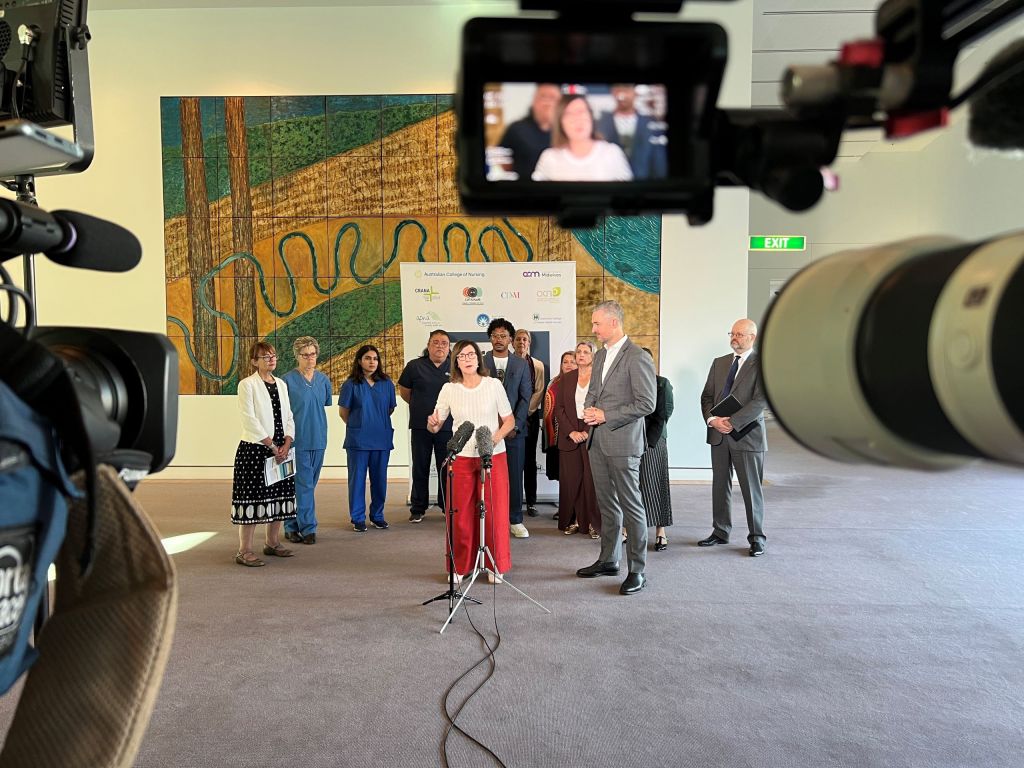
More than 20 nursing and midwifery organisations have gathered at Parliament House today to demonstrate how Australia’s largest health workforce could play a far greater role in strengthening primary care, if long‑awaited Medicare reforms are implemented.
The Showcase of Contemporary Nursing and Midwifery, hosted by the Parliamentary Friends of Nursing, brought clinicians, educators and service providers into the Mural Hall for a hands‑on display of nurse‑ and midwife‑led care. The event featured advanced assessment skills, wound closure, street‑based healthcare, remote monitoring tools, aged care innovations and regional models such as the Women’s Health Mobile Clinic.
The message to parliamentarians: Australia is not making full use of the workforce best placed to address rising rates of chronic disease, worsening preventable hospitalisations and widening gaps in rural and remote care.
Call for Medicare reform
Leading organisations, including the Australian College of Nursing (ACN), Australian College of Midwives (ACM) and the Australian Nursing and Midwifery Federation (ANMF), are urging the federal government to act on the 2024 Scope of Practice Review, which recommended changes to allow nurses and midwives to work to their full scope.
Nearly one‑third of primary health care nurses are not routinely working to the full extent of their expertise. According to sector leaders, this represents a major untapped resource at a time when Australia records higher rates of preventable hospitalisations than the OECD average, costing the system an estimated $7.7 billion a year.
“Australians are rightly proud of Medicare, but the system is under extraordinary pressure, and we are failing to make the most of our most distributed clinical workforce,” ACN chief Professor Kathryn Zeitz said.
“The Scope of Practice Review, and review after review of the primary healthcare system have already told governments how to fix this. We have the evidence – now we need the action.”
A preventable burden
A significant proportion of preventable hospital admissions are linked to chronic conditions such as diabetes, heart failure and chronic respiratory disease.
Evidence shows nurse‑led models of care can reduce hospitalisations and readmissions, particularly in rural and remote areas where nurses outnumber medical practitioners five to one.

“Primary health care nurses are highly educated and experienced healthcare professionals, but the data shows that almost a third are not working to their full scope of practice,” Australian Primary Health Care Nurses Association (APNA) president Denise Lyons said.
“If we act on funding reform and other recommendations of the Scope of Practice Review, we can do more to tackle chronic disease and reduce hospitalisations.”
Midwifery leaders say the same problem exists in maternity care, where continuity‑of‑midwifery models consistently deliver better outcomes but remain underutilised.
Privately practising midwives represent just over two per cent of maternity services, despite evidence showing they deliver the most positive birth experiences and the lowest rates of birth trauma. The default public hospital model costs the system around 20 per cent more than community‑based midwifery care.
“When poor health outcomes are preventable, the system has failed to act early enough,” ACM chief Mia Dhillon said.
“For women and babies, this means ensuring access to continuity of midwifery care provided by midwives working to their full scope. Continued underuse of this workforce is holding back better outcomes, and it must change.”
Highlighting what’s possible
Remote monitoring and telehealth tools highlight how nurses can extend care into homes and rural communities, while aged care innovations and advanced practice models show how nurses and midwives deliver complex care in remote areas.
Continuity midwifery care models were part of the Showcase, demonstrating the strong outcomes achieved when midwives support women throughout pregnancy, birth and early parenting.
The Women’s Health Mobile Clinic – staffed entirely by nurses – demonstrated how mobile, community‑based care can close gaps in sexual and reproductive health, wellbeing checks and cancer screening across rural Victoria.
“Nurses and midwives are at the frontline of healthcare and are uniquely placed to identify community needs and deliver innovative, person-centred solutions,” ANMF federal secretary Annie Butler said.
What nursing and midwifery leaders want
The organisations are calling for Medicare settings to be updated so nurse‑ and midwife‑led care can be funded and scaled. Their key asks include:
- Implementing the recommendations of the 2024 Scope of Practice Review
- Directing the proposed Baseline Practice Payment to nurse‑led primary care
- Allowing nurse‑led clinics to register for MyMedicare and access bulk‑billing incentives
- Enabling Endorsed Midwives to access multidisciplinary care funding, including bundled payments and primary care incentives.
“Nurse‑ and midwife‑led models are safe, proven and already working in communities across the country,” Professor Zeitz said.
“With the right funding settings, they can reach the Australians the current system leaves behind.”