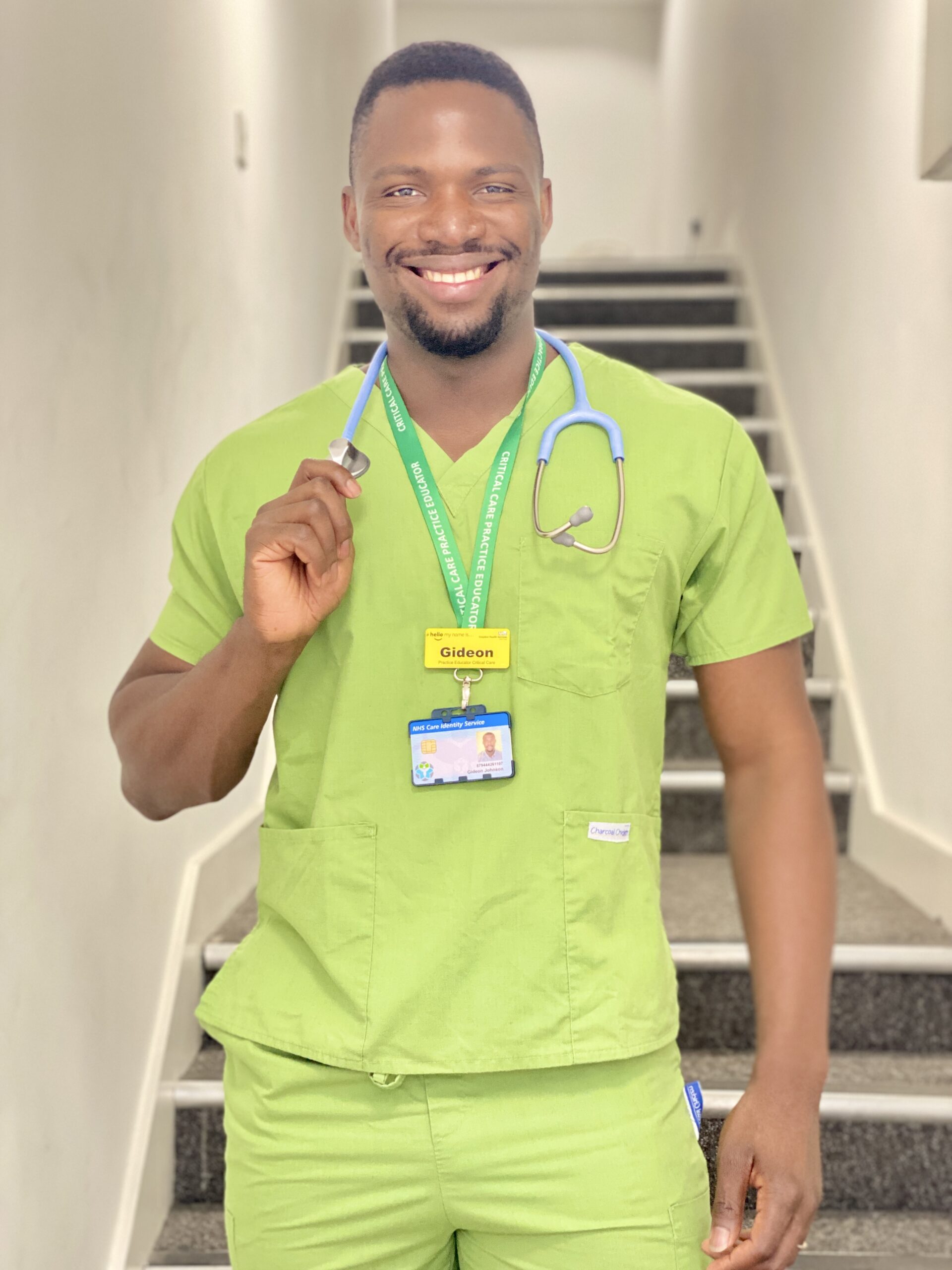
A young nurse has been recognised for his dedication to improve healthcare delivery across three continents.
Charles Sturt University recently awarded their prestigious Distinguished Alumnus Award to Gideon Johnson.
Throughout his ten-year career, Gideon has pursued university degrees in both Nigeria and Australia, and gained experience as a nursing intern, critical care nurse, and ICU specialist in London and Australia.
While he was born in Nigeria, Gideon is an Australian citizen and has American family roots.
He currently lives in London with his partner, Nicolas, and works as a senior manager.
"I am honored to be recognised as the Charles Sturt Young Alumnus of the year," he said.
"It goes a long way to show that hard work does pay off, regardless of your geographic location or background."
NR: What was your response to winning the award?
It's an incredibly huge honour for my colleagues, peers, and the university.
It goes a long way to show that hard work pays off, regardless of your geographical location and background.
It's been one of the highlights of my professional career and achievements.
And did you know early on that you wanted to work in nursing?
My interest in health started when I was a child.
All I knew was I wanted to be a doctor.
I went to medical school, but when I migrated to Australia, it wasn't feasible to continue pursuing that line of traditional medical roles.
That was when my interest and passion for nursing started, and I went to study for a Bachelor of Nursing at Western University.
Earlier in my nursing studies, I identified that I was going to specialise in the intensive care unit.
To me, nursing wasn't just a job or career; it inspired me to become an influential leader.
That was my ambition and aspiration, and through my service to humanity, I wanted to become a highly influential leader who inspires positivity and change in our society.
That ambition has continued to drive me towards nursing, and I wouldn't choose anything else.
What aspects do you like most about nursing?
It's the privilege to bring meaning and make a difference in someone's life.
Working in the intensive care unit where people are almost always near death, I want to help people as best as possible.
I subspecialised in a major trauma intensive care unit, which involves accidents relating to the brain.
It means I have to be on the frontline, navigating complex health issues, saving lives, critically thinking on my feet and determining worst-case scenarios or possible deterioration.
The most rewarding part is seeing that hard work and that person making a difference.
Someone can wake up from life support and finally speak, say your name or even recognise you.
I just don't think there is any other feeling in the world that can be better than seeing the faces of your loved ones or the appreciation of life.
The majority of these people go ahead having a second chance at life, and knowing that I'm part of that journey is priceless today.
I can also imagine that it's a stressful and challenging environment to work in.
Yes, it's very challenging, especially during the pandemic.
It was a lot of pressure to take on a more significant number of patients and have more people under my care than I would usually have, with rules and policies changing frequently in response to the pandemic.
And that was when I felt close to that maximum psychological resilience.
I felt I needed to be strong for my junior colleagues and people looking after me.
I worked in Australia at the start of the pandemic, but in the middle of the pandemic, I moved to London and worked in one of the major hospitals here.
I got involved with having up to six critically ill patients under my direct care, with the support of non-specialist nurses and healthcare workers.
These patients' intensive care decisions and support were resting on my shoulders as a senior nurse, and these people were looking up to me.
So, it was just managing my psychology and stress and trying to support others emotionally.
It was a very confronting time, but I just reminded myself of why I was doing it.
I reassured myself of that privilege.
I sought counselling and psychological support professionally during that time to help me get through it.
Being that role model, educator, and support to others was also a gratifying feeling that helped me get past that time.
Could you tell me about your volunteer work mentoring young students from culturally and linguistically different backgrounds?
I started youth mentoring in Melbourne, Australia.
These were youth from refugee backgrounds who migrated to Australia.
I helped them teach English, find resources that would link them to the community, understand the Australian community, and get the best shot at passing the high school certificate and getting into university.
When I moved to London, I worked in a large metropolitan area with huge cultural diversity.
I was mentoring Vietnamese nurses and non-clinical staff individually, understanding their aspirations and goals, as well as their strengths and limitations.
The majority of them, coming from culturally and linguistically diverse backgrounds, struggled with not having the language to correct words and also finding the resources that would enable them to get further in their career.
Having that role model, someone who understands where they're coming from, helped them contextualise these goals.
I helped review their CVs and supporting statements, which are quite big here, and did lots of sessions around preparation and technique to help them become more confident.
I saw them applying to jobs at higher positions than they were previously.
And even though not all of them got the job at first, the majority of them got it later.
Do you feel your background made it sometimes more challenging to work and advance in this career?
Yes, absolutely.
I didn't know how my accent developed, but obviously, it's from multiple places.
But I did my best to learn correct English and speak to be understood.
However, I knew that it wasn't always favourable in certain contexts where people are used to a particular way of speaking English.
So, in those environments, it took me some time to find a way to be understood or communicate.
Also, I'm of a minority ethnicity, so it wasn't always easy to prevent people from making assumptions about my skin colour.
Sometimes it felt that I had to prove myself, and sometimes even when I hadn't spoken, there was always the assumption I couldn't speak English well.
Imagine being in that situation where you've already been judged before you can show yourself or people know you.
And I find I'm spending time working in that environment trying to prove that's not all there is to me.
I have much experience and can offer much more than people initially tend to think of me.
Obviously, it's sometimes very challenging, but I have always been around reminding people to be accepting, open-minded, and embrace diversity.
And there, I'm privileged to be in a senior management position where I get to be the one monitoring those things around the practice to ensure that diversity is on the agenda.
And that I can my best to protect others from these assumptions in the day-to-day nursing job.
What are your plans for the future?
I plan to introduce a novel intervention in one of the central London hospitals here, leveraging my PhD into academics towards becoming a professor.
I feel that's where I will be able to translate the evidence-based practice I have towards educating the nursing workforce from the start.
While doing my PhD, I aspire to go up to the director level within my current practice.
Currently, I'm the senior manager, and I'm hoping to be able to get to the director position towards the executive decision-making level.