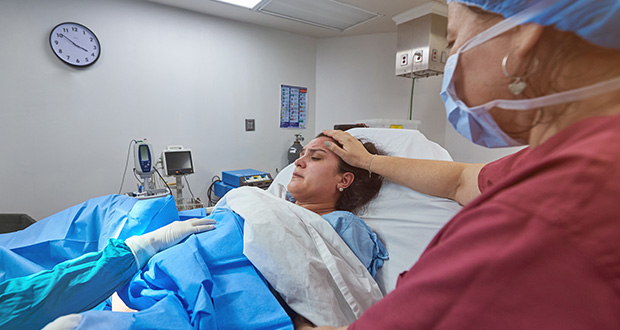
A chronic shortage of midwives in public hospitals is causing women to be discharged without proper postnatal care, midwives have said.
Earlier this year, NSW hospitals had over 500 vacancies for full-time midwifery positions, resulting in women leaving hospital within two days after childbirth.
Chair of NSW's Australian College of Midwives branch Vanessa Scarf says while there's a widespread staff shortage, postnatal care is particularly impacted.
"The throughput in hospitals is so intense that women are sent home without adequate postnatal guidance and education," Scarf says.
"After a woman has a baby, the care she receives is absolutely paramount to her success.
"But this also impacts health service in general and contributes to hospital readmissions."
During postnatal care, midwives monitor the woman's and baby's health and provide education on looking after the baby.
But when there's poor postnatal care, health complications such as infections and anaemia are more likely to occur for mother and child.
Additionally, midwifery support can provide mental support and combat anxiety and depression after birth, which affects one in five women.
Yet, Scarf says chronic staff shortages have put midwives in an 'impossible' position to provide adequate postnatal care.
"The workload in the hospital is just extraordinary – it's extremely busy," she says.
"And staff members are just dropping and dropping because the workload is just too extreme."
A lack of available staff has meant that in some hospitals, two midwives had to take care of up to twelve women with their babies.
The NSWNMA also suspects a tool used by hospitals to calculate mandatory midwifery staffing levels may be faulty.
Birthrate Plus helps hospitals plan rosters according to the minimum standard of one-to-one midwifery care for women throughout labour and birth.
"Whether that algorithm or the way the hospital uses the funding is flawed, something is lost along the way," Scarf says.
The UK-designed birthrate tool was introduced to Australian healthcare in July 2010 and was initially welcomed by NSWNMA.
Now, the union has seen a 'mismatch' in the number of mothers allocated to a midwife's regular shift.
"When a midwife is allocated their load for the shift, the tool has only worked out the mothers, not the number of babies they have with them, which can be more than one," Scarf explains.
"So, a great day might be when a midwife has four women with four babies, but those days don't happen very often.
"Most often, a midwife is allocated between six to eight women, which translates to up to 16 patients."
To meet safe staffing levels, Scarf says hospitals have replaced midwives with registered nurses, enrolled nurses, and sometimes assistants in nursing.
"But they're not actually trained to provide midwifery care.
"In public hospitals, midwives should provide pregnancy, birth, and postpartum period exclusively."
Scarf says hospitals also prioritise assigning midwives to birth units and antenatal wards over postnatal care since registered nurses can't replace them.
"Postnatal care has always been a poor cousin of maternity care – it lends itself to being undervalued."
She emphasises the importance of postnatal care for women, especially those at a higher risk of health complications after childbirth.
"Postnatal care is not just looking after a woman who's just had a baby – it's so much more," Scarf says.
"Overall, midwifery continuity of care has huge impacts on health outcomes, such as preterm births.
"We need more staff and better midwifery models of care so that midwives can practise to their full potential."