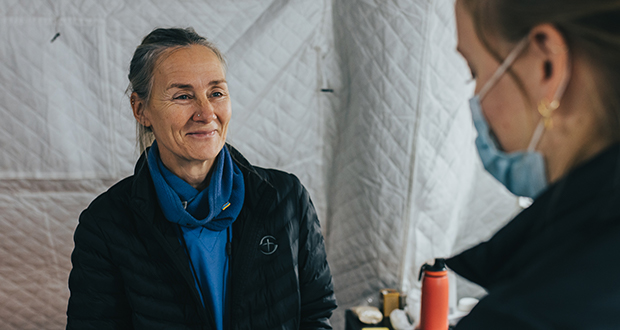
Nursing Review spoke with Tricia Miller, a laboratory technician based at the Samaritan’s Purse Emergency Field Hospital (EFH) in Lviv, the largest city in Western Ukraine.
Tricia serves with the Samaritan’s Purse Disaster Assistance Response Team, which trains and deploys health workers during times of crisis and disaster.
NR: Can you describe the current situation in Ukraine in terms of access to healthcare?
Tricia: The healthcare system is not swamped in Western Ukraine, however elective surgeries and non-acute patients are currently being turned away from hospitals/clinics so that they can focus on trauma needs.
Although the hospitals in the East are functioning, they do have major supply shortages.
How have you seen this affect local communities and health care workers?
I personally haven’t come into direct contact with health care workers in hospitals or other facilities because my work is focused on the emergency field hospital.
However, there are many contributing factors in the local community – the influx of internally displaced persons (IDPs), separation of families, males 18-60 unable to leave Ukraine, etc. Individuals are affected in different ways depending on their unique circumstances.
Healthcare, as a sector, is by default drastically affected by conflict. Ranging from death and trauma, to the constant stress of an unknown, from hunger and dehydration to difficulty sourcing normal medication whilst being displaced.
What are the greatest challenges of providing health care/relief in an active war environment?
The logistics of bringing in equipment and personnel, and then the ongoing process of maintaining supplies and the personnel required for clinics and the emergency field hospital is complex.
But, perhaps the less obvious challenge is building and fostering relationships and referral pathways for patients to get into our clinics/emergency field hospital. We have medical clinics/mobile clinics at transport hub(s) and IDP refuges which equate to us going to the patient.
This creates an indirect pathway to the emergency field hospital. Word-of-mouth throughout the community too, has been effective, but it takes time to build the positive reputation so that builds momentum.
The unknown and shifting nature of conflict also means that our direction and planning has needed to be fluid. And obviously, the safety of personnel is also a priority in decision making.
What is your role as a DART Laboratory Tech on a given day?
I have a small field laboratory set up next to the emergency field hospital. This allows me to run point-of-care testing on blood and urine. We have microscopy, blood typing and various rapid tests are available too.
My area of expertise is in biochemistry and microbiology which overlays well with what we have available. It is a field hospital though, and so we are limited with what we can assess, however, we have the resources of a local laboratory, and hospitals, for those tests/patients outside the scope of our capacity.
What do you assist with?
Additional to the laboratory, I help as much as possible in other areas. This has mainly been in the distribution of medical supplies. Supplies for surgery, laboratory, IV, ortho, respiratory, OR and general medical aid are brought into the emergency field hospital base, unpacked and then repacked according to modality before being shipped to relevant hospitals and clinics in areas heavily impacted by conflict.
What drew you to serve?
I have had a desire to be involved with missionary type work since I was very young. I was introduced to Samaritan’s Purse through my daughter who has done a lot of volunteer work previously and she applied with the Samaritan’s Purse Disaster Assistance Response Team – DART.
I have a strong desire to help and serve at the international level in acute circumstances, and Samaritan’s Purse gives me the unique opportunity of being able to help and serve, whilst utilising my professional skills, and doing this from a Christian foundation.
How has your work in Ukraine compared to any other experiences as a nursing professional, e.g. working in a hospital in Australia?
I was deployed early in 2020 in Cremona, Italy, as part of the DART response to COVID-19 in that region. This was at the very beginning of the pandemic and like this Ukrainian response, there was uncertainty and concern from family and friends. Both these responses have presented unique challenges to the team which were largely unknown at the outset, making the logistics and the direction of the response itself very difficult to predict.
Working in a laboratory/pathology in or associated with a hospital in Australia is relatively systematic, with workflow and anticipated outcomes for each day. Namely specimens come in, procedures are followed, and the results go out – nary a patient in sight! And you are employed for a specific role which is generally, clearly defined.
Here in Ukraine, and previously in Cremona, the workflow is less predictable. There is patient interaction and this usually includes a translator. Although the laboratory is my responsibility and this is my primary role, I have spent many hours helping with the medical supply distribution, helping with the delivery of lunches to medical clinics outside the emergency field hospital, and supporting others in their roles wherever possible.
Whether in the laboratory, talking with our translators or other nationals, or simply helping on the emergency field hospital base, there is a sense of importance in even the smallest of tasks.