
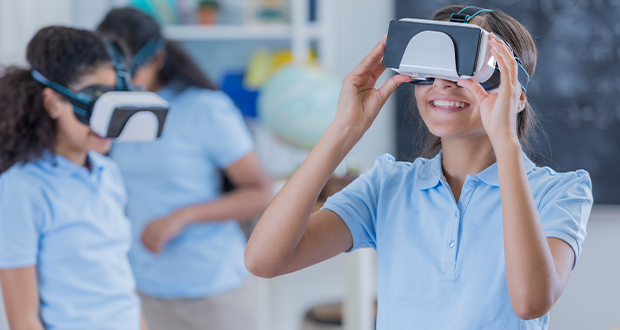
Virtual reality (VR) is helping to create safer birthing experiences for Queensland mothers and their babies in remote towns.
Nurses in the remote and predominantly Indigenous towns of north-west Queensland are learning how to prepare mothers for childbirth with the help of VR.
Using the platform Bundle of Rays, which creates immersive learning experiences for healthcare workers, North West Hospital and Health Service (North West HHS) launched its first package on clinical management of presentations of pregnant, labouring and birthing women, and emergency neonatal care.
“Staff will have the chance to experience simulation scenarios by wearing headsets. The immersive training experience will help build confidence and proficiency in clinical staff across our remote facilities and prepare them in case there is an emergent or unexpected birth,” North West HHS midwifery educator Helen Bailey said of the package.
In communities such as Doomadgee or Julia Creek – where expectant mothers are hundreds of kilometres away from the closest midwife in Mount Isa – clinical nurses on site are critical to ensure safe births.
"[With the VR] I can pick up a stethoscope, put it in my ears, and listen to heart sounds. I can listen to lung sounds, I can dress a patient, put ECG dots on," Ms Bailey said.
"We teach [the nurses] how to care for a woman, how to make them comfortable, how to provide that service until we can retrieve those women."
North West HHS chief Michelle Garner said introducing VR helps close the distance between remote health workers and education delivery in Mount Isa.
"The utilisation of VR is responsive to the changing environment of today's healthcare needs and supports the health service in being an agile and connected health system," Ms Garner said.
"We are thrilled to be at the forefront of this new technology, which will allow us to provide high-quality training to our staff across rural and remote facilities."
"The benefits of this approach are significant, and we are excited to see the impact it will have on patient care and outcomes."
The lack of maternity services in Queensland is a longstanding problem. The government introduced new initiatives to boost these services in rural and remote areas at the beginning of September.
The initiative is allocating funding to train 20 GPs to advance in obstetrics training through a diploma program, additional funding to train doctors, nurses, and midwives on best-practice woman-centred care and collaboration, and boosting First Nations midwifery models of care services.
The Minister for Health Shannon Fentiman said the schemes would play a more prominent role in the future of midwifery.
Nonetheless, labour shortages continue across the north-west Queensland's healthcare sector.
Last year, a permanent GP was recruited to Julia Creek – a town of 500 people, 250 kilometres east of Mount Isa – after two years without one.
The town's offer of a rent-free house and an annual salary package of $500,000-plus failed to attract suitable applicants until an online news story drew attention to the town's situation.
"The remote sites are the worst places to attract staff and even retain staff," Ms Bailey said.
"It's really hard."
The North West HHS hopes using advanced technologies such as VR in its training toolbox will help upskill staff and attract more workers to the region.

1 Comment
michelle mcelroy
I am somewhat dismayed and confused with a couple of things in the story. Firstly, the title states helping ‘midwives in rural Qld deliver babies’ – Midwives do not need help in delivering babies, it is remote nurses that are being helped because there are no midwives. I am also confused with the statement by Ms Bailey chosen for the story “[With the VR] I can pick up a stethoscope, put it in my ears, and listen to heart sounds. I can listen to lung sounds, I can dress a patient, put ECG dots on,” this statement has no relevance to the use of VR with delivering babies and I am sure there was something more related stated that could have been used.
Having this technology is fantastic for the nurses working in remote areas and will assist them in gaining new skills and confidence in maternity care. It is a shame that does not come across as well as it could.