I don’t think I heard a word after she said, ‘you have cancer’.
As my husband and I sat across from my breast surgeon, I’m pretty sure I went straight into shock. The world continued to spin on its axis but it was as though everything around me went blurry and out of focus.
As I reflect back on that day, there are so many things I wish I’d known then. The kind of things you can only glean through experience and time.
I'm fortunate to have come 'out the other side' of cancer; alive but not unscathed.
I would’ve loved for a woman who had traversed this path before me to somehow infuse her wisdom and learnings into me so I might navigate this bumpy, uncharted territory with a little more ease and grace.
There are a few things I wish I’d known when I was diagnosed with cancer.
Stop, breathe, check-in with yourself
I have been diagnosed with cancer twice. And on both occasions the surgeon delivered their findings in a clinical, matter-of-fact way like my take-away order was ready. To her, I was just another patient but for me, I was not accustomed to hearing such words. I can assure you, nothing prepares you for it, and I doubt anything ever could.
When I was diagnosed for the second time, my breast surgeon was very quick to provide her diagnosis and proposed treatment plan. She was keen to conduct a lumpectomy to excise the rogue cancer cells growing in my chest within a matter of days, and urged me to meet with an oncologist immediately too.
I was already in a state of shock after discovering I had cancer for the second time, so the thought of heading straight into surgery and chemotherapy was significantly even more shocking.
I felt like my life was a whirlwind with all the many scans and appointments that now filled my calendar. I felt poked and prodded and at the whim of doctors who were complete strangers to me.
What I wish I knew was that I could've actually stopped, taken a big, deep breath between my diagnosis and commencing treatment. If I had my time again, I would like to have hit the proverbial ‘pause’ on everything to gather my thoughts, do my own research and check-in with myself to ensure that the proposed treatment plan felt right for me. Surely a bit of extra time for me would not have affected my health too gravely.
Enlist the help of a key support person
Most people when they're first diagnosed with cancer go into a state of shock, denial and anxiety. They fear the prospect of facing something so uncertain and potentially life-threatening. I felt like my whole world got thrown upside down and I went into a state of shock.
I wish I knew to consciously choose a key support person that would accompany me to all of my appointments, that could help me to do research and gather information, and help me to make informed decisions at a time when I wasn’t functioning at my best.
Build an amazing medical team to support you
I discovered throughout my cancer journey that each medical specialist I dealt with along the way had a different approach, a different mindset, a different energy and a different level of expertise.
Doctors are medically trained and tend to adopt the ideals and practices bestowed on them in medical school and evidence-based treatment. Doctors are unique and individual so it is incredibly important to build a medical team that you feel aligns with you and your ideals.
It's very important to shop around and make sure that you find the right surgeon, the right oncologist, the right radio-oncologist to support you along your journey. What I didn’t know in the beginning is that I had a right to question what my doctors were telling me. And if I’d had the courage, that I had the right to choose which doctors I wanted to work with.
Be informed
When you are navigating uncharted territory, it's difficult to know what information to look for, where to find it, and what information to ask so you can equip yourself for the journey ahead.
What I wish I knew was to ask loads of questions. Your doctor is there to inform and support you. Take time to source information about your diagnosis and proposed treatment from other sources like the Cancer Council and other reliable agencies.
People may surprise you
People show up for you in only the ways they can.
From my very earliest days in treatment I had an expectation, albeit an unspoken one of those I imagined would be my support team throughout the journey ahead. What I wish I had known was that different people will show up in different ways for you. Some of the people who you most expect will be there for you may not show up for you at all.
They may not be able to cope with your illness or disease. This was one of the most confronting and challenging aspects of my journey. I questioned why some people didn't show up for me or weren't able to show up for me at a time when I needed them most.
The silver lining however, was that a number of people that I least suspected would be there for me came out of the woodwork and offered their full support.
I came to a place in my treatment journey where I marvelled at who did show up and I appreciated and enjoyed every message, letter, gift, phone call and the unique ways that each person showed up to support me along my path.
No energy to ‘fight’ cancer
I intuitively knew I didn’t have the energy to ‘fight’ cancer.
In a world full of ‘crush’, ‘conquer’ or ‘fu*k’ cancer slogans, I didn’t think meeting the cancer growing inside my chest with anger and fear was going to be the best pathway to help heal it. After all, that is the approach I took the first time I was diagnosed with cancer. And just 4 years later I was confronted with a second, more aggressive cancer diagnosis.
I wanted to find a more peaceful way to ‘meet’ my cancer, explore why this unwanted visitor had shown up again in my life so abruptly and find gentle ways to make peace and heal from cancer so I wouldn’t have to travel this path a third time.
Cancer doesn’t define you
A cancer diagnosis can send shock waves through you and those around you. However, it doesn’t need to define you. Cancer is a serious disease and needs to be tended to, but it is only just one part of you. And there are so many other parts… like your interests, your work, your relationships, your dreams.
I wish I’d known to keep a healthy perspective about who I was after my diagnosis, and that cancer was part of my experience but was not my whole experience in life.
Introduce stabilising practices that bring you calm
What I wish I knew is just how powerful the practice of meditation is to help bring calm and groundedness to an overrun nervous system. From the onset of my diagnosis and into treatment, I discovered meditation to be one of the most valuable activities that I engaged in to help me cope. Meditation helped me to manage my emotions, to ensure I kept a sense of calm about me when my world seemed to be upside down.
Journal your feelings
I learned that going through cancer treatment is just as much a physical journey as it is an emotional one.
I personally found journaling my feelings to be a powerful way to express what was going on within me. It was a safe place to explore my inner landscape, my thoughts and feelings without fear of judgement or repercussion.
Talking to friends and family or perhaps a therapist are wonderful ways to share what is going on for you. However, I found the power of writing to self-express and bring calm to a cocktail of emotions swirling within me was an instrumental component of my healing journey. I wish I knew just how powerfully healing the practice of writing is to connect more fully with my experience and how I was travelling it.
Finding the gifts of cancer
Having been diagnosed for a second time with cancer, I intuitively felt that cancer had shown up for a reason. I believed in some way cancer had an important message for me and that this powerful teacher was here to gift me something.
As I journeyed through treatment, I chose to mine the gifts from this experience and discovered there are many.
I wouldn't wish cancer on anyone, however I know that my life is better for having had this experience, and I would not want to return to my life before cancer.
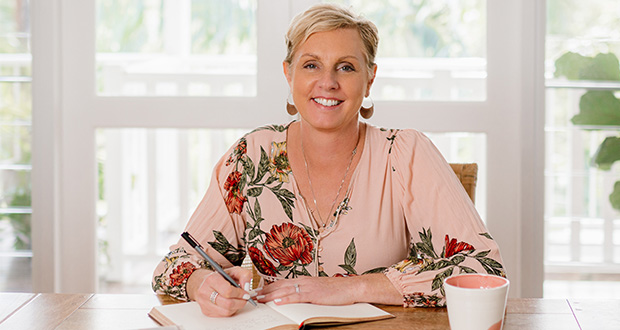
Cindy Scott is a Sunshine Coast-based two-time breast cancer survivor, author, speaker, resilience coach, and founder and CEO of Evolving Women Co.