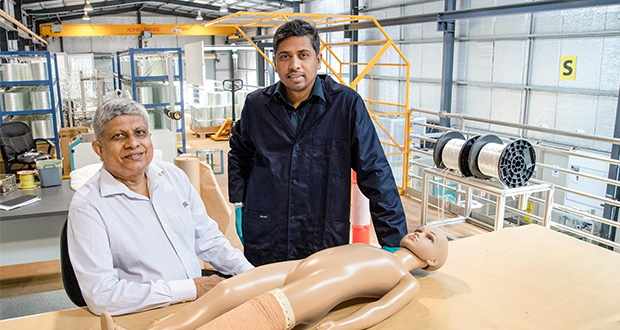
With 170,000 Australians breaking a bone annually, University of Southern Queensland PhD student Janitha Jeewantha thought it was time to redesign the old way of casting injuries.
With help from his professor, Jeewantha developed a hybrid shape memory polymer 'smart plaster' which has been shown to wrap around a fractured limb more efficiently than traditional Paris (POP) and fibreglass casts.
“The smart plaster is lightweight, has less setting time, is easy to apply, and the process is cleaner and quicker," Jeewantha told Nursing Review.
“A major benefit is that it allows multiple alterations, which is not possible with a traditional cast.”
Most hospitals in Australia still use the 19th-century POP and fibreglass casts, which have been found to be unhygienic, heavy and cumbersome.
“POP and fibreglass casts often report pressure sores, create compartment syndrome, and limit blood flow to arteries and muscles during swelling,” Jeewantha said.
“Therefore, cell damage may occur sooner when temperature and pressure are coupled, leading to ulcers, nerve damage, or permanent loss of body parts.”
The new plaster allows doctors or nurses to control the pressure between the fabric and skin, reducing the chance of nerve damage.
The process also takes less than 10 minutes, whereas POP requires around 45 minutes to set completely.
“We included a secondary locking mechanism, which makes it easy to remove and doesn’t require a saw that can scare kids,” Jeewantha said.
Proper cast care is important in lowering the risk of complications after the cast is removed.
Jeewantha says his creation can greatly assist nurses in rural areas who often lack staff or medical equipment.
According to federal health statistics, people living in rural and regional areas are more likely to obtain an injury and have poorer access to medical services than those living in metropolitan areas.
“Smart plaster is ideal for first aid and emergencies in remote or isolated locations where required medical facilities and assistance are not available or accessible,” Jeewantha said.
Jeewantha's plaster is also made of biocompatible material, which releases less environmentally unfriendly chemicals in the air than POP plasters.
“Shape memory polymers can recover their original shape after being deformed, which means our smart plaster can also be reused," he said.
“Well-known biocompatible polymers are expensive and not freely available in the commercial market.
“Therefore, we were careful to use commercially available low-cost biocompatible epoxy polymers during the smart plaster synthesis process.”
Associate Professor Jayantha Epaarachchi, who supervised the development of the plaster, said the new plaster could be the new standard of injury care in the years to come.
“We have done our part to produce a material that can provide comfort to patients, flexibility to doctors for frequent observation, easy and less time-consuming application for nurses and is relatively cheap and recyclable,” Epaarachchi said.
“This would be a turning point in the orthopaedic treatment process."