Nurses in regional NSW fear that ongoing staff shortages and daily changes in exposure sites will leave them overwhelmed in the coming weeks, advocates have told Nursing Review.
Health authorities have flagged the Central Coast as a growing area of concern as the region reported 22 cases overnight.
“I think the fear of what’s to come is aggravating everyone's anxiety,” said Michelle Cashman, a NSWNMA counsellor and Central Coast delegate.
“We have to be prepared, and it’s all well and good for the government to say ‘we’re building a ward here, we’ve done this’, and yes, we’ve got more ventilators, but a Covid patient who is incubated takes six staff. If you’ve got many Covid patients in an ICU, that’s a lot of work.”
The state’s healthcare system is under increasing pressure, with a surge in over 2,000 cases a day predicted for next month according to recent government modelling.
Data shows a peak in hospitalisations and ICU demand in late October, with cases expected to rise in mid-October in Sydney’s LGAs of concern.
Cashman, a registered nurse, said regional staff are working daily double night shifts have been told to reduce plans for leave and for holidays to prepare for the coming weeks.
“It’s the beginning of September, and we’re looking at six to eight weeks of holding your breath and wondering what's next.
“I think the fear is that if we had more lockdowns and if the patient load gets higher, where will staff come from?
“The workload for the average nurse is pretty great at the best of times, let alone with those extremes on top.”
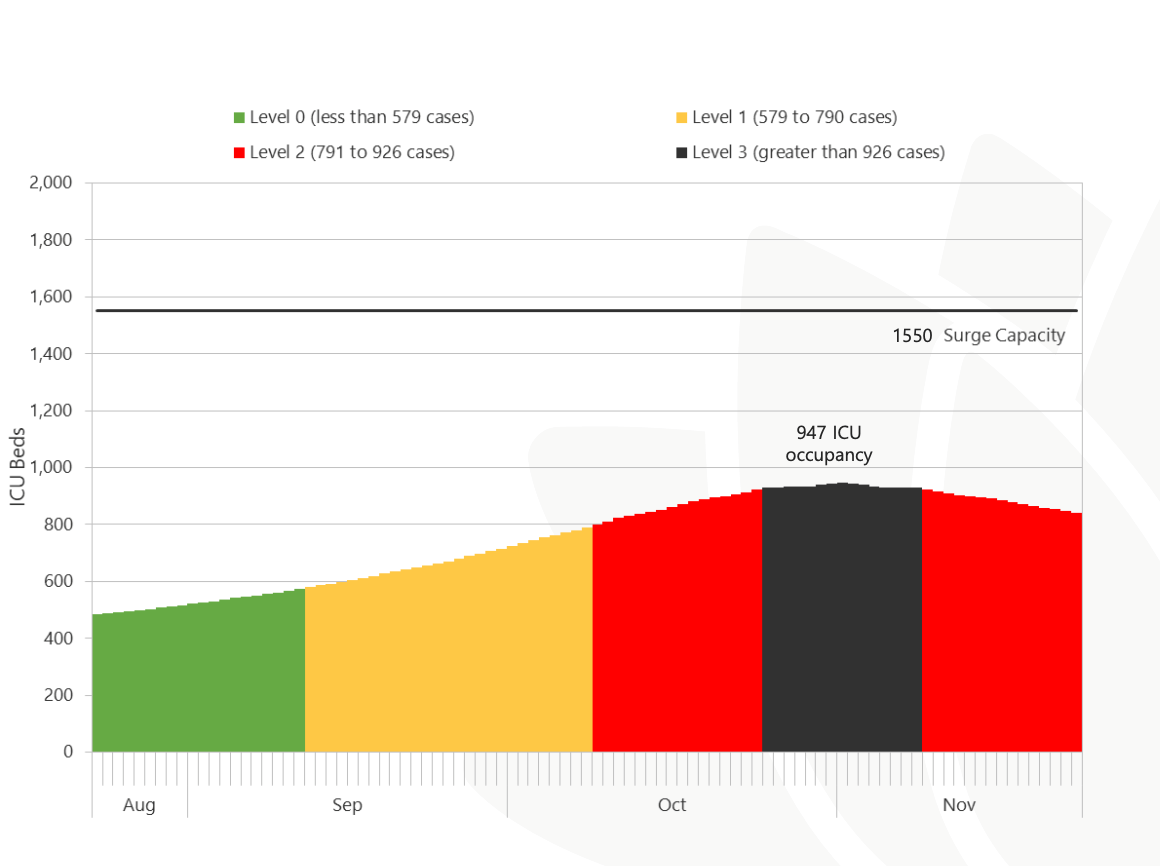
New modelling from Melbourne’s Burnet Institute showing a rise in ICU capacity in NSW. Source: NSW Health
Sixty-five per cent of the 279,484 people living on the Central Coast have received their first dose, with thirty-five per cent fully vaccinated.
As of yesterday, dozens of hospital staff and patients were sent into isolation after a confirmed positive case visited an emergency department at Wyong hospital.
Last minute isolation orders are leaving gaps in staffing rosters and forcing workers to take on 16-hour shifts, according to Cashman.
“I feel the anxiety is so high, and there are predictions that this could get so much greater,” she said.
“Staff are really worried, and they’re worried because some of them are young mums going home to families, some of them have older parents as well, and there’s that fear of what you are potentially going to bring home.”
Day-to-day operations at local hospital wards have also been significantly affected, according to Cashman, with routine surgeries being cut to accommodate staffing and wards.
A parliamentary inquiry into the working and staffing conditions in NSW rural and regional hospitals is currently ongoing.
“The staff shortages have been an ongoing event for a long time, we’ve been trying hard to get ratios because we know that's the best care that we can provide,” said Cashman.
“Nurses provide physical and medical care, but we also provide emotional care too, and unfortunately that’s really hard and at the moment the needs of the patients are so great.”
Earlier this year, nurses and midwives across the Central Coast walked out on shift to demand the government introduce staff-to-patient ratios.
According to Cashman, local health authorities have signalled that hospitals would be able to cope with a large-scale outbreak.
“According to Central Coast Health, I think they think they are prepared, and the impression I get from the staff is no, that is not the case,” she said.
“People aren’t in the ICU for one day, they are in there for a couple of weeks or more, so if the best outcome happens, they are still needing a lot of care for a long time.
“There is a limit to what can be provided, and I just hope to God that we never see that maximum limit reached right across the entire area.”
Staff in regional hospitals across the state’s regions are also reporting higher levels of stress due to increased workloads, according to NSWNMA assistant secretary Shaye Candish.
“Most of the hospitals in the state are taking some other type of work to try and relieve the stress from some of those hospitals where we have got the highest pressures due to Covid,” she said.
“Even if they are not directly affected, what we’ve seen is the hospitals really trying to get through high numbers of elective theatre cases or substantial planning assuming the outbreak will reach them at some point.
“In addition to that, we are seeing nurses go and assist in vaccine hubs and special health accommodation, so it has reduced the pool of workforce the hospitals have to draw upon.”
In response to the impending strain on NSW hospitals in the coming weeks, the government has released a four-level plan to map out how the system will cope under increased pressure.
The strategies include using private hospitals and allocating a higher number of patients per staff member.
Candish said there are “more questions than answers” as to how the plan will work due to a lack of detail.
“We’ve seen the government for the first few months of this outbreak claim that there was nothing to see here and that everything in the hospitals was fine,” she said.
“What they’ve done now is try to manage expectations of nurses and midwives and other healthcare workers by saying it will get worse.
“Now we’ve got this workforce plan, and even that doesn't outline where the nurses are coming from.”