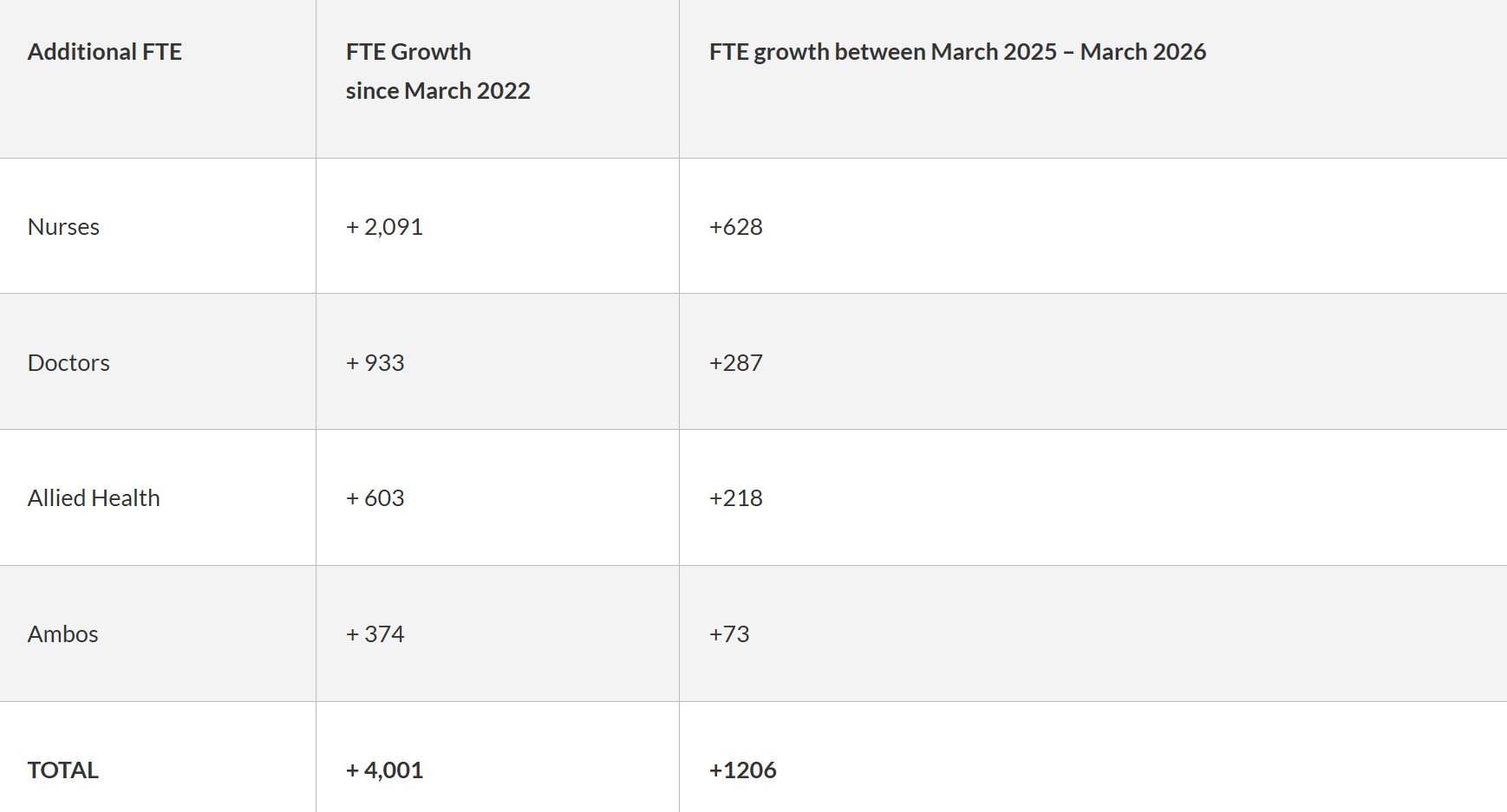
South Australia has recruited more than 4,000 additional frontline health workers in the past four years. New data shows significant growth across nursing, medical, allied health and ambulance staffing as the state continues efforts to strengthen its public health system.
SA Health figures show 4,001 full‑time equivalent (FTE) workers have been added above attrition since March 2022. The largest increase has been in nursing, with 2,091 extra nurses, followed by 933 doctors, 603 allied health professionals and 374 paramedics.
The workforce expansion coincides with more than 600 new hospital beds opening across the system since 2022, requiring additional staff to support increased capacity in both metropolitan and regional areas.
Minister for Health and Wellbeing Minister Blair Boyer said the latest figures reflect meaningful progress in strengthening the state’s health workforce.
“These 4,000 additional full‑time equivalent staff above attrition have been welcomed into hospitals and health sites across every part of our state and are making a real difference to the lives of our communities,” he said.
While metropolitan networks recorded the biggest overall increases, including 1,789 additional staff at the Central Adelaide Local Health Network and 1,044 at Southern Adelaide, some of the most dramatic growth occurred in regional South Australia.
Doctor numbers in the Yorke and Northern Local Health Network rose from just two in 2022 to 19 in 2026, an 850 per cent increase. In the Eyre and Far North region, doctor numbers grew from three to 21, a 600 per cent rise.
The SA Ambulance Service also reported a 26 per cent increase in paramedics statewide.
Minister Boyer said the strong regional uplift demonstrates the government’s commitment to improving access outside Adelaide, while acknowledging that attracting clinicians to smaller communities remains a challenge.
“Seeing such strong growth in regional doctor numbers shows this government is serious about improving health care beyond metropolitan Adelaide. We know there is more to do but this is a great start to strengthening services in regional communities right across the state,” he said.
To support recruitment, the government is offering incentives of up to $40,000 for doctors and relocation subsidies of up to $15,000 for eligible staff.
“We will continue to invest in our health workforce to ensure South Australians can rely on a world‑class public health system,” Minister Boyer said.
Winter Demand Plan
The state government has also released its 2026 Winter Demand Plan this month, outlining measures to manage increased pressure on hospitals during what is typically the busiest time of year.
“Ensuring a sustainable and responsive hospital system remains a priority,” Department of Health and Wellbeing Executive Clinical System and Improvement deputy chief Robyn Lindsay said.
“This includes additional hospital capacity, increased transition care beds to support timely discharge, and strengthened community-based care to ensure patients can access appropriate support outside the hospital setting.”
A key feature of the plan is a new 16‑bed Northern Crisis Stabilisation Centre at the Lyell McEwin Hospital precinct, due for completion in late June. The centre will provide a dedicated alternative to emergency departments for people experiencing mental health crises or suicidal distress, offering short‑term intensive support while freeing emergency departments to focus on acute medical care.
More than 230 beds have been added across the system since May 2025, with further beds to open this winter. The State Health Coordination Centre, which operates around the clock, will oversee system‑wide capacity and coordinate patient flow across metropolitan and regional hospitals.
The plan also embeds allied health staff earlier in discharge planning to help patients recover safely at home and reduce unnecessary time spent in hospital. Up to 50 new transition care beds will open at College Grove through a partnership between the Central Adelaide Local Health Network and Amplar Health, supporting timely transfers for patients who no longer require acute care.
Targeted virtual care models will be expanded to support older people and those at higher risk after discharge, helping maintain continuity of care and reducing avoidable readmissions.
The plan also includes expanded influenza vaccination options, including a needle‑free nasal spray vaccine for children aged two to under five. Through the National Immunisation Program, injectable flu vaccines remain free for around 600,000 South Australians at higher risk of severe illness.
“This is about making sure our health system is prepared, responsive, and focused on patient care,” Minister Boyer said.
“It’s great to see additional influenza vaccination options for younger South Australians being offered, including an influenza nasal spray vaccine as a no-needle alternative.
“These are key measures that will protect South Australians and support our hospitals when there is higher demand.”